
This is the fifth post in a series on motivation and engagement in the workplace.*
Two people on your team are both strong performers. Both care about the work. You manage them the same way — same check-ins, same praise, same goals — and one thrives while the other slowly checks out.
The difference is almost always motivational. And it's invisible unless you're looking for it.
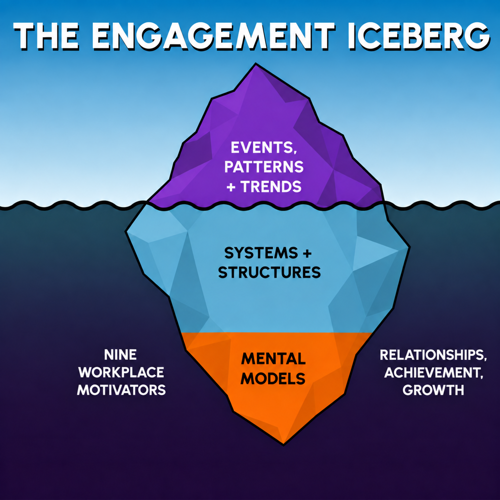
In this series, we've discussed how the engagement iceberg starts with a visible surface of the events and trends of the quarter down to the layer underneath that actually drives all of it, quarter after quarter. This series is about that bottom layer that represents what people believe, value, and expect from their work. It's where engagement is really won or lost.
9 motivators, 3 clusters
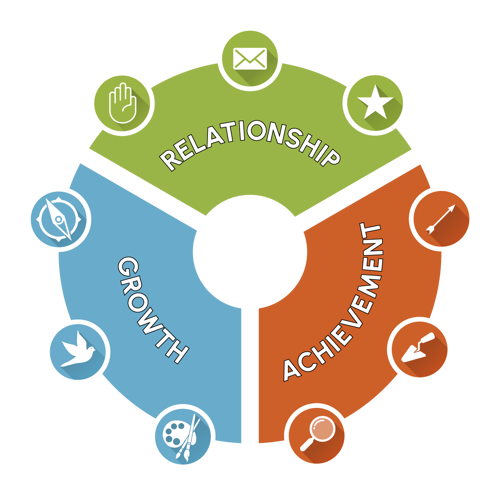
Everyone carries nine workplace motivators. What differs is the priority of those motivators for each of us, and whether our current role and responsibilities are meeting the motivators we value most.
The nine motivators sort into three clusters. Relationship motivators focus on security, community, and recognition. Achievement motivators focus on reward, expertise, and influence. Growth motivators focus on freedom, creativity, and meaning. No motivator is superior to another, and unlike personality or skill set, what motivates us changes over time and as our roles and responsibilities change.
What the order reveals
Go back to those two strong performers. The first person's top motivators are Expert and Searcher: mastery is central, and they need to know the work connects to something larger than the task. Communication and goal setting with them should focus on where they can apply their expertise and have a positive impact. Feedback that acknowledges their work and gives them an opportunity to explain their thinking or reasoning will be much better received than applauding them during a team meeting or promoting increased revenue.
The second person's top motivators are Star and Director. They're currently energized by acknowledgement and by having genuine authority. They do their best work when their contributions are visible and when they own something outright. The public praise here would land much better than for the other person, and conversations around projects or responsibilities they can take more leadership on will be more engaging.
The same management approach can't work for both. What the first person needs is challenge and context; what the second needs is visibility and latitude. Manage them identically and at best you’ll reach one but not the other, and at worst you’ll fail to engage either of them. Good managers need a map for their employees and their team.
Curious what disengagement is already costing you? Try our free ROI calculator to put a number on turnover, lost productivity, and manager effectiveness.
A live reading over a fixed type
Most personality assessments answer a fixed question: who are you? They produce a profile for how we think, behave, and communicate that is assumed to remain steady. Mojo™ answers a different question: what do you need from your work right now?
That matters, because motivation is a current state, not a permanent trait. The person who joined three years ago energized by creative challenges may now be driven mostly by stability and belonging. When life outside work shifts, our priorities shift with it. The nine motivators don't change. Which ones are most active, and how well they're being met, does.
That's why a mojo profile is revisited on a regular cadence rather than taken once and filed. Priorities move gradually in stable stretches and faster around transitions — a new role, a new manager, a change at home — so the map stays current instead of describing who someone was at onboarding.
There is no bad profile
Nothing in one’s motivational map describes a weakness or flaw. The nine motivators carry no hierarchy. A person whose strongest drivers cluster around Defender — security, structure, clear expectations — is fully capable of exceptional work. So is the person driven by Spirit and Creator, who needs room to move and freedom to do things their own way. What each needs to perform at their best is simply different.
That reframes most quiet disengagement. It usually isn't an attitude problem. It's a gap between what someone needs from their work and what they're actually getting, a gap that goes unaddressed because no one understands it well enough to communicate meaningfully about it. Mojo gives you the insight and language for those conversations.
See more than the tip of the iceberg
A manager working from motivator data doesn't have to guess what a one-on-one should focus on. They know whether a direct report needs more autonomy or more structure, more recognition or more meaning. That turns a generic check-in about observed work into a specific conversation about engagement.
When a motivated person starts to drift, a manager without context is guessing from the behavior they can see. A manager with a motivational map can ask a sharper question: which of this person's core needs has gone unmet, and for how long? Managers can see past the tip of the iceberg into the core of what is driving their people.
That's the difference between reacting to a resignation and preventing one.
Want to know what drives each member of your team? Book a discovery call with SparkMotiv.
*Other post in the series:
Why Your Best Employees Quit Before Your Survey Sees It Coming
Why Your Engagement Survey Can't Tell You What's Wrong
Why Recognition Programs Don't Build Culture
Your Personality Test Has No Idea If Your People Are About to Quit
People Join Companies. They Quit Teams.