
This is the first post in a series on motivation and engagement in the workplace.*
Your best performer gave notice on Tuesday, and nothing in last quarter's engagement survey warned you. The score was fine. The one-on-ones were fine. Then they were gone. And the exit interview gave you a reason so vague it could have meant anything.
This happens because the tools most companies use to track their people are looking in the wrong place. Surveys report sentiment; personality assessments label traits; reward points chase behavior — all near the surface, where the warning signs show up last. What actually drives someone out the door sits deeper, in what they need from their work and whether they're getting it. That's the layer mojoTM is built to monitor and support.
Managers react to what surfaces. The cause sits lower.
Managers react to events: dropping engagement scores, notice from a strong team member, deadlines slipping in the schedule. Reacting to problems matters, but is it effective management?
It usually isn't. Each event is the visible tip of something larger, and the response — a counteroffer, an all-hands meeting where the wrong questions are asked, a team lunch — leaves the part you can't see unchanged. So the same kind of events show up again next quarter.
Systems thinkers have a name for this picture. They call it the iceberg, because what we see and react to is only part of the issue, and it explains why most workplace initiatives to address culture produce motion without much change.
A quick map of the engagement iceberg
The iceberg model sorts what happens in any organization into three levels, stacked by depth. The higher levels are easy to see and low in their capability to effect real change. The lower levels are harder to see, but they are where the real leverage sits. Leverage is about small shifts that can produce big changes, especially when intervening in complex systems where well-placed changes compound powerfully over time.
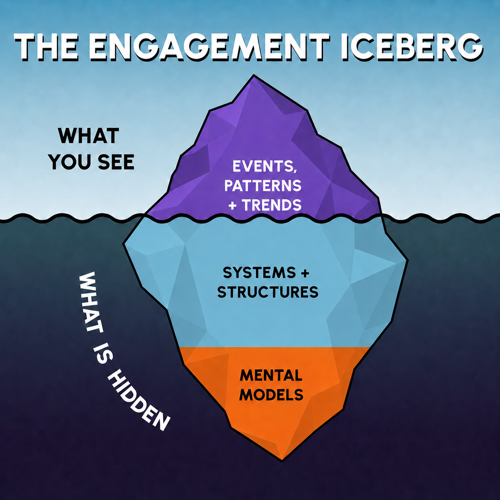
For a leader, the practical takeaway is short: The tools most companies buy operate in the top layer. The change companies want lives below the surface.
Above the waterline: where most tools stall
Engagement surveys live near the surface. Employees experience each one as an isolated event that comes and goes. Run annually, surveys may show a trend, which can be useful. They may tell you that disengagement is rising, but they don’t tell you why. And they carry a hidden cost: when people answer honestly and see nothing change, the next survey reads as proof that their voice does not matter. A poorly handled survey can deepen the disengagement it set out to measure.
That is why SparkMotiv's surveys are customizable and anonymous, and the reporting flows straight into leadership planning. So asking employees to voice their experiences leads somewhere visible. Measurement at the surface is fine if it’s a first step to digging deeper. And employees can tell whether something is being done to change the playbook or simply check a box.
Reward and recognition platforms sit nearby, one layer down. They try to move behavior with points and perks. But for most employees they don't do much because the gesture is impersonal — a free meal for a 60-hour week reads as a transaction — and over time the perk stops feeling like recognition and starts feeling like an entitlement. Financial or material incentives can work to a point, but they always have diminishing returns and unintended consequences.
Personality and behavioral assessments go deeper still. They describe how a person naturally thinks and works, individually and on a team, which is real and useful knowledge. But a profile is taken once and rarely revisited; it leaves out everyone hired after the rollout and says nothing about whether a person is energized or burning out today. Plus, it creates a real burden on managers and HR to interpret the results and create meaningful action. The best intentions and insights go nowhere if there is no time or structure to regularly use them.
Curious what disengagement is already costing you? Try our free ROI calculator to put a number on turnover, lost productivity, and manager effectiveness.
Below the waterline: working where leverage lives
For employees, the actions they take, or events they trigger, are the top manifestation of their motivation, or lack thereof. At the deepest level sit their values, beliefs, and aspirations — the inner fire that decides how much of themselves they contribute to their work. This is the mental-model level, and it is where mojo operates.
Mojo provides a map of a person’s motivators and how well each motivator is being met. Unlike a personality or skills assessment, motivation changes over time and in response to roles and responsibilities. Major life or workplace changes — a department reorganization or a new role, for instance — may call for a fresh motivational map.
A single map, on its own, is just an event. However, it does reveal the mental models driving your employees — what they value, what energizes them, and what can demotivate them. Instead of reacting to an event, mojo uses those motivators to inform how your people are energized to work and collaborate. The results become a shared conversation between employee and manager, leading to a personal Motivational Action Plan that both of them own. The responsibility sits on two sides at once — the employee and the workplace.
When mojo is implemented consistently across quarters, something structural appears where there used to be a once-a-year snapshot: a steady flow of information about what your people need, arriving in time to do something about it. In systems terms, that recurring feedback loop is one of the highest-leverage changes a leader can install.
The 9 motivators in brief
Mojo maps motivation through nine distinct motivators. They group into three clusters:
Relationship motivators, covering the need for security (Defender), belonging (Friend), and recognition (Star)
Achievement motivators, covering the pull toward reward (Builder), expertise (Expert), and influence (Director)
Growth motivators, covering the desire for freedom (Spirit), creativity (Creator), and meaning (Searcher)
Every person has some combination of these nine motivators, with their top three being extremely important and the bottom ones potentially demotivating if overly emphasized.
The case the bottom line cares about
The result of met needs is compounded interest, not a completed checklist. A person whose drivers are understood and supported engages more fully, and engagement shows up in productivity, performance, and retention. All of these have real cost benefits. The cycle starts with the individual, which is exactly where the work begins.
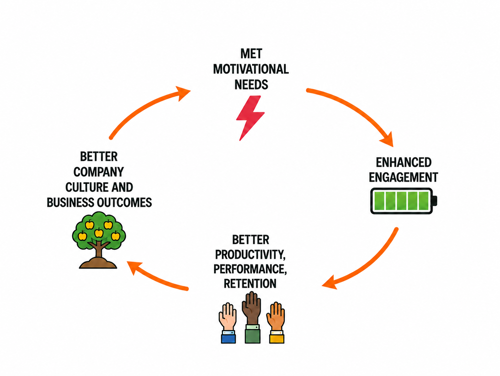
The cost to implement mojo is small — a fraction of what you already spend on each employee, and far less than what losing one of them costs. For a few dollars a person each month, you get a clear read on what actually drives your people and the means to act on it before disengagement turns into a resignation. Measured against the price of turnover, it pays for itself quickly.
A different picture of the workplace
Imagine a workplace where leaders know what fuels each person on their team, where asking for employee voice builds trust because action visibly follows, and where motivation is a managed signal rather than an annual surprise. That workplace renews itself from the inside out, one person's inner fire at a time. But the tools at the surface will never build it. The work happens deeper. And it’s work worth doing.
Ready to see what's below your organization’s waterline?
Book a discovery call with SparkMotiv.
Sources
Finegood, Diane. "Iceberg Model."
Meadows, Donella. “Leverage Points: Places to Intervene in a System."
Senge, Peter. The Fifth Discipline: The Art and Practice of the Learning Organization.
*Other post in the series:
Why Your Engagement Survey Can't Tell You What's Wrong
Why Recognition Programs Don't Build Culture
Your Personality Test Has No Idea If Your People Are About to Quit
The 9 Things That Drive Your Employees
People Join Companies. They Quit Teams.