
This is the second post in a series on motivation and engagement in the workplace.*
Your engagement survey is giving you accurate data. That's the problem. It's measuring something real — how engaged your people are, right now, under their present workplace conditions. What it can't tell you is why those conditions exist, or what would actually change them. A score of 24% engaged tells you where you are. It says nothing about how you got there or how to get somewhere better.
In 2026, Gallup's State of the Global Workplace reported US engagement at 31%, with 52% of workers quietly quitting (doing the minimum) and 17% actively disengaged. That’s about 7 out of 10 employees self-reporting that they are not engaged at work! The numbers are painfully precise. But they’re almost useless as a guide to action because they measure the symptoms of the problem, not the cause.
The cause sits below the waterline
If you read the first post in this series, you already have the picture: engagement is an iceberg. What a survey measures is the tip — the visible events, patterns, and trends above the waterline. What produces those results sits below it, in the deeper layers a survey was never built to reach. At the very bottom is motivation: whether the work connects to what actually drives each person. Motivation is the cause. Engagement is what shows on the surface when that cause is met, or isn't.
That's the whole measurement problem in one image. Your survey can see down to the waterline and no further. It reads the surface honestly and reports it back to you. But the thing that determines your engagement score — the motivation underneath — is exactly the thing the instrument can't see.
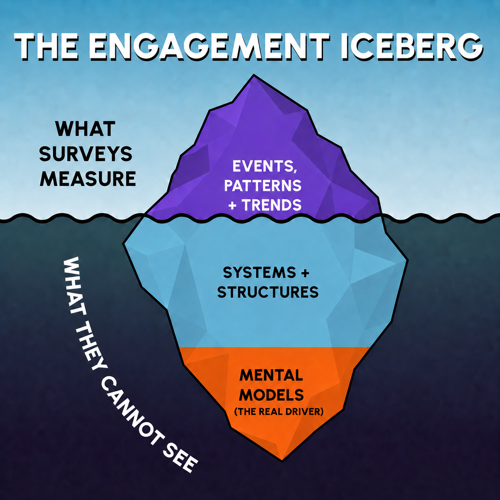
Most organizations have built their entire people-measurement system around the surface: annual engagement surveys, pulse checks, employee Net Promoter Scores. Every one of them reads the tip of the iceberg. None of them reaches the base. So you end up with a precise, well-validated number that tells you a problem exists without any insight into its cause.
What the gap costs at the decision point
The failure shows up the moment a manager tries to act on a score. A 6.2 out of 10 on “I feel valued at work” tells them something is wrong and nothing about what to do. Most respond with what they can control: a check-in, a recognition moment, a team lunch. These are reasonable reactions to the available information. They are not proactive, because the score never revealed what's actually wrong.
The right move depends on knowing why motivation is low for a specific person. Someone whose core need is autonomy, and whose satisfaction has been sliding for 3 quarters, is not “having a bad week.” They're in a role that's grown more constrained. Someone whose need for mastery is unmet needs a different conversation than someone whose sense of belonging has eroded. On an engagement survey, all three look the same. But below the waterline, they're three different needs with three different responses.
The gap compounds at the organizational level. Qualtrics research found that while 60% of US employees have a formal channel to give feedback, only 30% say their employer acts on it. That gap usually isn't indifference. It's because surface data rarely reveals what to act on, so the action items come out as generic as the data: better communication, more recognition, clearer goals. Generic in, generic out.
Curious what disengagement is already costing you? Try our free ROI calculator to put a number on turnover, lost productivity, and manager effectiveness.
Measuring below the waterline
The difference between measurements above and below the waterline is the difference between measuring what happened and understanding why, the source of the problem.
That's what mojoTM is built to measure. Rather than asking people to rate their experience of the organization, mojo maps the specific motivators driving each individual: which are active, which are satisfied, and where the gap between what someone needs and what they're getting is widest. A manager working from that data knows which conversation to have, not from intuition or trial and error, but from a clear picture of what changed and why.
The difference is sharpest in attrition. By the time someone hands in their resignation notice, the signal has been building for months, accumulating in the gap between what they needed and what the role gave them. Reading the deeper layer means catching that signal while there's still time to respond. That's why mojo monitors quarter over quarter: a person whose motivation has been sliding for 6 months looks nothing like one who had a rough week, and a manager with that data can tell them apart.
The survey isn't the problem
None of this makes engagement surveys unscientific. The best of them are rigorous. The issue is what these instruments measure — the conditions of engagement at the surface, not the individual motivators beneath them. You can run the most validated survey in the world and still not know what motivates a single person on the team. That calls for a different instrument for a different layer.
Surveys still earn their place. At scale, they reveal patterns across an organization that no single manager can see from their desk. That's why our own Culture Health Index (CHI) is built to feed action rather than file a report. A survey wired to a response is useful; a standalone score wired to nothing is the problem this post describes. The point isn't to abandon the survey. It's to stop asking it to do a job it was never designed for — and to pair it with something that reads the layer it can't.
Why this matters past the dashboard

There's a reason to get this right that goes beyond the metrics. A lack of motivation doesn't stay at the office. Eight hours of going through the motions doesn't end when someone logs off. It follows them home, into their families, into the parts of life that have nothing to do with work. An organization that treats disengagement as a measurement problem rather than a human one pays a cost that never shows up cleanly on a dashboard.
Reading the deeper layer is also a more honest posture. It says we want to understand what actually drives you, not just how satisfied you are with the conditions we built. That shift — from measuring satisfaction to understanding motivation — changes the relationship between an organization and its people. And when it happens, something starts to move: motivation deepens engagement, engagement improves performance, performance builds the kind of culture that keeps people. The cycle reinforces itself, but only once you're measuring the right layer.
Want a survey that's wired to action, not just a score? See how the Culture Health Index works.
Sources
Gallup. State of the Global Workplace 2026.
Harter, James K., et al. The Relationship Between Engagement at Work and Organizational Outcomes: Q12 Meta-Analysis, 11th Edition.
Qualtrics. “Employee Onboarding Surveys: What Questions to Ask and Why.”
*Other posts in the series:
Why Your Best Employees Quit Before Your Survey Sees It Coming
Why Recognition Programs Don't Build Culture
Your Personality Test Has No Idea If Your People Are About to Quit
The 9 Things That Drive Your Employees
People Join Companies. They Quit Teams.