
This is the third post in a series on motivation and engagement in the workplace.*
Here's the uncomfortable thing about recognition programs: they tend to work better for the people who designed them than for the people who receive them. The designer gets a dashboard, adoption metrics, and evidence that something was done about engagement. The recipient gets a badge, a point total, a shoutout. The intentions behind both are genuine. The model underneath them is the problem.
The carrot was designed for horses
The carrot-and-stick model dates to the era of industrial labor. Offer a reward to drive a behavior, apply a consequence to correct it. The analogy wasn't rhetorical — it described how workhorses were managed. It carried into management theory because it worked, after a fashion, for repetitive physical tasks where compliance was the goal and the output was simple enough to measure and reward.
Most of the work people do today is different. It takes judgment, creativity, sustained effort, and the willingness to actually care about the outcome. None of that can be conjured with a gift card.
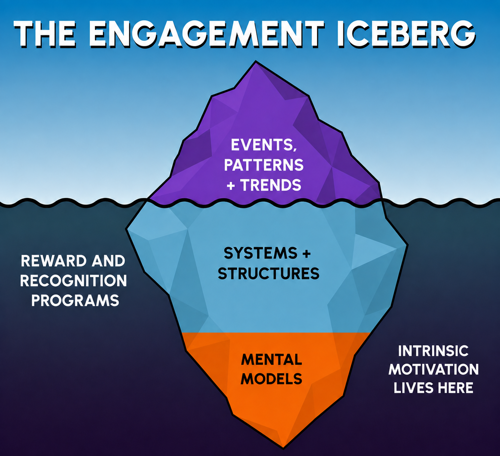
Reward programs sit in the middle of the engagement iceberg: a structural fix aimed at behavior, not at the drivers underneath it. They can affect both events and trends, as well as some systems and structures, but they rarely drive intrinsic change in employee behavior, thinking, or engagement.
Rented motivation doesn't last
Behavioral psychology has known the limits of rewards for decades. In a meta-analysis of 128 studies, Deci, Koestner, and Ryan found that tangible, expected rewards consistently undermined intrinsic motivation — one of the most-tested findings in the field. When people are paid to do something they were already motivated to do, the reward gradually becomes the reason they do it. Take the reward away, and the behavior often goes with it. Motivation built this way isn't built at all. It's rented.
That's the core problem with engagement platforms built on points, badges, and recognition mechanics. They're well-engineered delivery systems for a model of motivation science has largely moved past. The packaging varies — standalone platforms, modules inside a larger human resources (HR) system, points engines bolted on through integrations. The model underneath doesn't.
The numbers bear it out. In a 2024 analysis of enterprise recognition programs, over 90% of organizations had a rewards or recognition program in place, but only 31% of HR leaders rated their program's effectiveness as high. Nearly everyone runs one. Almost no one thinks it works.
Curious what disengagement is already costing you? Try our free ROI calculator to put a number on turnover, lost productivity, and manager effectiveness.
Same reward, different people
There's a second reason recognition programs disappoint, and it's the one most organizations miss. Even where recognition genuinely motivates, it doesn't motivate everyone the same way.
For some people, being recognized is real fuel. They do their best work when their contributions are visible and named. For many others, it's pleasant but neutral: a shoutout is nice, but it changes nothing about their effort. And for a few, being singled out in front of the room is actively uncomfortable, even demotivating. A program that applies the same gesture to everyone produces exactly the inconsistent results you'd expect — because it wasn’t built to account for the fact that people are motivated by different things.
9 different motivators
Understanding motivation first requires understanding that motivators aren't uniform. There are nine different motivators, in fact, and they sort into three clusters:
Relationship motivators — they pull toward security, belonging, and connection
Achievement motivators — they pull toward mastery, reward, and influence
Growth motivators — they pull toward freedom, creativity, and meaning
To learn about each of the basic drivers of employee motivation, download SparkMotiv’s free guide, The Nine Motivators.
Where each motivator ranks in importance to an individual determines what actually moves them — and whether a public award lands as fuel, as noise, or as something they'd rather avoid.
That individual specificity is what mojo™ reveals. Rather than assuming everyone is motivated by the same things, mojo determines which motivators are most important for each person and how well the person’s role is meeting those motivators..
Recognition doesn't disappear. For those people who are naturally motivated by it, points or a shoutout does its work. For others, recognition is transformed, depending on what most motivates them. For some, that's increased autonomy. For others, it's increased guidance, or it's an opportunity to lead or innovate. And mojo recognizes that these things change for individuals. Through regular check-ins using mojo, managers can focus on the work their employees care about using language their employees appreciate and respond to.
Keep the recognition. Aim it better.
None of this means you should scrap your recognition program. Basic acknowledgment of good work is essential. And for some of your people, targeted recognition is one of the strongest levers you have. But it’s not a universal tool. Knowing who on your team is truly moved by it — and what’s moving those who are not — is the difference between checking off a box and building real culture.
Want to know where recognition falls in your motivational profile? Get a map of your motivators.
Sources
Deci, Edward L., Richard Koestner, and Richard M. Ryan. “A Meta-Analytic Review of Experiments Examining the Effects of Extrinsic Rewards on Intrinsic Motivation.”
HR Research Institute. HR.com's State of Rewards and Recognition Programs and Tools 2024.
*Other posts in the series:
Why Your Best Employees Quit Before Your Survey Sees It Coming
Why Your Engagement Survey Can't Tell You What's Wrong
Your Personality Test Has No Idea If Your People Are About to Quit
The 9 Things That Drive Your Employees
People Join Companies. They Quit Teams.