
This is the sixth post in a series on motivation and engagement in the workplace.*
A company's culture is vital for its mission and overall alignment to the work. But while culture is often defined or discussed from the top down as if it were monolithic, it never is.
Companies with hundreds of employees, numerous teams, and distinct departments have subcultures, some of which may operate differently — and feel quite different — from one another. This is normal in any healthy organization, but it requires acknowledging that culture is really built from the teams up, not from a founding vision.
A company’s reputation and perceived culture can attract talent, but employees’ experience with their team decides whether they stay, how much effort they give while they are there, and what they say about the place afterward.
The team is the unit that matters for engagement
Workplace researchers Marcus Buckingham and Ashley Goodall analyzed 19,000 employees across 19 countries through the ADP Research Institute (ADPRI). They found that the most powerful predictor of whether someone was fully engaged was simply whether they did most of their work on a team. People who were identified as being the most engaged did more work compared with their colleagues.
“The team is the reality of your experience at work.” — Buckingham and Goodall
Furthermore, a team's culture is concrete and daily. The decisions, interactions, and communication from managers and colleagues are what people on a team feel acutely and affect them more deeply than the handbook or quarterly updates from leaders. While it is important for an organization to communicate clearly across all levels and departments, it is vital that communication be clear, positively aligned, and consistent in teams.
Trust in the team leader is the differentiator
Being on a team versus working independently roughly doubles the odds that someone is more engaged. One thing doubles it again: deep trust in the team leader. In the ADPRI data, 8% of people who work alone are fully engaged. On a team, that number is 17%. And on a team with deep trust in the leader, it’s 45%. Team members who strongly trust their leader are eight times as likely to be fully engaged as those who do not.
That finding has a hard edge. The trust has to be extreme to count. Someone who merely agrees that they trust their leader looks about the same as someone who actively distrusts theirs. There is no partial credit.
So how does a leader build trust? According to Buckingham and Goodall, frequent attention to the work of each team member is the anchoring ritual of team leadership. A short weekly conversation with two questions is efficient and sufficient: What are your priorities? How can I help? Leaders who have that conversation weekly see engagement levels well above those who have it monthly.
The simplicity of these two brief questions also solves the attention problem. When a manager has so many people that in-depth meetings with individuals become arithmetically impossible, the lack of important communication produces disengagement, burnout, and turnover. No leadership training fixes a math problem, but if the focus is on engagement and support, people will feel it and respond accordingly.
Curious what disengagement is already costing you? Try our free ROI calculator to put a number on turnover, lost productivity, and manager effectiveness.
A team is an iceberg too
Trust is built through meaningful attention, which means the highest-leverage role in your organization is not in the C-suite. It is the team leader who changes what happens in a weekly check-in.
Frequent light-touch attention is only half of it. People need to see that their leaders care, but it is also important that leaders respond in a way that works for each person individually and the team as a whole.
That’s a tall order for even experienced managers, and the difficult truth is that most team leaders are working without that understanding. They can see behavior: who is contributing, who has gone quiet, which pairs coordinate, and which have friction. Some tools can help with personality and communication style. But when two employees have two very different reactions to the same information and goals, it is likely more an issue of motivation than one of skills, personality, or attitude.
This series has used the engagement iceberg to explain the differences between surface events, systems and structures, and core motivators. The visible surface and deeper layers of structure rest on the motivational drivers that fuel everything above.
Applying the iceberg to a team is similar. Managers see visible behavior — how people communicate, whether deadlines are being met — and there are tools and assessments that can measure personality and how people think.
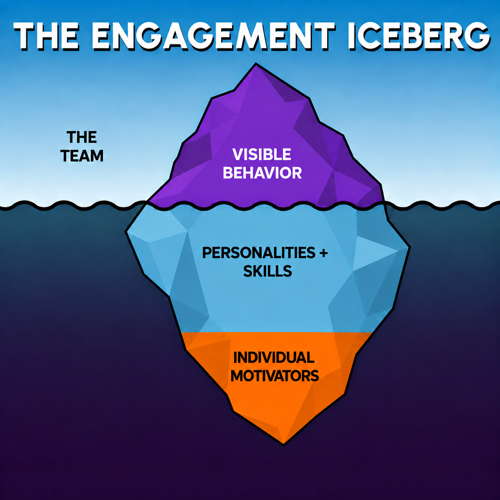
MojoTM works at the deepest level, mapping each person's unique combination of motivational drivers and building the team picture from that data. Managers see what each employee needs in order to do their best work, and what the team is made of in combination. Applying that insight makes weekly conversations productive and powerful and have more impact than addressing just what is at the surface.
What a team leader is actually managing
Everyone holds all nine motivators in some order, and the order shifts over time. A team's character comes largely from which motivators sit near the top for the people in it. The motivators sort into three clusters:
Relationship — security, belonging, recognition. The people who hold the group together. They build trust, notice when someone is struggling, and keep the culture from fraying under stress. A team short on this fuel can look productive right up until pressure hits, and then fracture.
Achievement — reward, expertise, influence. The engine of delivery. They organize, push toward results, and take ownership. A team short on this fuel drifts. A team over-indexed on it burns out chasing metrics, with nobody tending the relationships.
Growth — freedom, creativity, meaning. The people who keep the team from stagnating. They ask what if, bring new approaches, and connect the work to something larger. A team with none of this fuel executes today's plan well and misses the shift that makes the plan obsolete.
A leader who can see the mix knows where the team is strong and where it is thin: whether it has the relationship fuel to survive a hard quarter, the achievement fuel to ship, and the growth fuel to keep adapting. That is a composition you can manage toward.
Where to put your attention
Buckingham and Goodall’s research is blunt: Of all the leadership roles in an organization, the one that has to be the highest priority is the role of team leader. That is where engagement is made and lost. This matches data from Gallup and others that centers much of the employee experience around their managers.
Check in frequently with each person, and you have done half the job. Use the language around motivation they respond to — identifying what each person on the team runs on and what the team amounts to in combination — and the weekly conversations become energy for the team’s collective battery.
Want to see your team's motivational composition? Get a map of your team's motivators.
Sources
Buckingham, Marcus, and Goodall, Ashley. “The Power of Hidden Teams.” Originally published in the Harvard Business Review.
*Other post in the series:
Why Your Best Employees Quit Before Your Survey Sees It Coming
Why Your Engagement Survey Can't Tell You What's Wrong
Why Recognition Programs Don't Build Culture
Your Personality Test Has No Idea If Your People Are About to Quit
The 9 Things That Drive Your Employees