
Nobody rolls out a new learning initiative with the hopes it goes nowhere in three months and is the awkward topic at the quarterly meeting. The reviews were great, the trainer was charming and knowledgeable, and more than one participant had an "aha" moment. But fast forward a few months, and the business problem that triggered the training hasn't been resolved.
It's an expensive thing to get wrong, and it fails everyone at once. The executive team wanted measurable impact and didn't get it. The employees gave up two days and got a nice memory. The L&D team, which did nothing wrong, absorbs the blame for both.
Most trainings and assessments are given without a plan for integration
Often a training program or culture or people assessment is planned from the top. The initiators are almost all well-meaning, with the hope that employees both feel valued and become more valuable to the organization in the process. While many leaders seek input from department heads, managers, and employees to help guide what programs are delivered, there is rarely a plan in place at the beginning for integration or continued use of the learning.
So, once the training is completed, it’s almost always left behind — not because anyone lost interest, but because the results never change. Six months on, a manager who wants to revisit the training is trying to piece information and context together like a private detective. There's no fresh signal to react to, nor is there continuity from the training months ago to today.
The lack of impact across industries is measurable. A 2006 study by Alan Saks and Monica Belcourt, published in Human Resource Management, tracked how much training employees actually apply on the job: 62% immediately after the program, 44% six months later, and 34% after a year.
By the one-year mark, two out of three people have stopped using what they were taught. The content isn't the problem; the integration is.
Motivation is different in kind
What drives a person at work isn't made or broken by a single instance of training or assessment. It moves with the individual’s circumstances, their role, what's happening at home, what they just finished, and what's coming next.
Someone motivated by a need for security during a reorganization may be motivated by a need for challenge a year later. Being aware of that shift provides real information about how to lead and coach them.
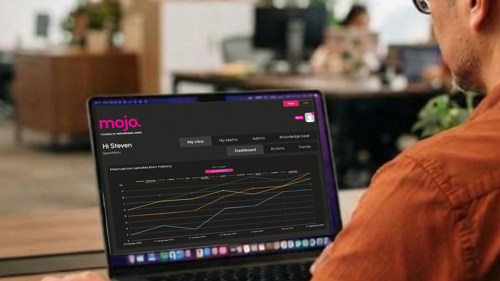
Mojo™ measures changes in motivation. It identifies which of the nine core motivators matter most to each person at the current moment. And it does so continually, reassessing the person’s motivational profile every quarter to track any changes that may be happening.
Each reading hands the manager and the employee new information, which means each follow-up has new material in it. Each conversation is fresh and relevant.
Curious what disengagement is already costing you? Try our free ROI calculator to put a number on turnover, lost productivity, and manager effectiveness.
What happens between maps
A map every quarter still leaves a quarter in between. That's where mojo’s motivational action plans do their work.
The employee and their manager build a plan from the employee’s latest motivational profile. Together they create a set of specific commitments covering what the employee believes will maintain or increase their motivation at work. Since each action satisfies a motivator that matters, the employee sees clearly how their commitment will benefit them.
The next map closes the loop and opens the next one. It shows whether the actions were completed and moved anything, and it re-anchors the new plan to what is motivating the person right then. A motivational action plan is a living document rather than a page in an old report.
What it changes for the manager
In How to Know a Person, author and columnist David Brooks argues that making someone feel understood is among the most consequential things one person can do for another.
For a manager, that means knowing what is driving an employee in the present moment. Their natural mode of communication may not change much. Their aptitude for critical thinking may hold steady for a career. What always — and often — changes is what moves them to communicate at all or to bring that thinking to a problem instead of doing the minimum.
Mojo gives managers a continual read on their employees. Someone who needed firm guidance and clear direction a year ago may need freedom to work out a problem in their own way today. It’s the same employee but a different requirement.
Where the change comes from
Go back to the training that got great reviews. The content was good. The people in the room learned something real. And most of them could still apply it if asked to. What they lost wasn't the skill, it was the reason to use it.
When a person's motivators are named, acted on, and revisited, their reasons to engage stay visible to them and their manager and become a focal point instead of a data point of additional information. Capability and willingness stay in the same place at the same time, which is how training turns into performance.
A company’s desire for change through workshops is well-intended and important for overall organizational development. By incorporating mojo and continually discussing the motivators important to each person, organizations gain a tool for making the training sticky.
Great reviews tell you about the room. What changes the company is when people are still applying the training months later.
See what your team's motivation profile actually looks like. Book a discovery session with SparkMotiv.
Sources
Saks, Alan M., and Belcourt, Monica. "An Investigation of Training Activities and Transfer of Training in Organizations." Human Resource Management 45, no. 4 (2006): 629–648.
Brooks, David. How to Know a Person: The Art of Seeing Others Deeply and Being Deeply Seen. Random House, 2023.