
Connections and relationships matter to everyone, but they energize and motivate some people far more than others. Employees with a high Friend motivator thrive on interpersonal relationships. They may even stay in a role mostly because they like the people they work with.
They also need a specific kind of attention if there are changes to the ways a team interacts. When in-office colleagues become tiles on a screen and relationships shrink to action items in email summaries, the Friend motivator goes unmet. Managers often don't see it until the employee is already disengaged or gone.
What the Friend motivator needs in a remote, hybrid, and in-office workplace
The Friend motivator centers on belonging and rewarding relationships at work. It isn’t about the need to be in the office or to spend long amounts of time socializing. Rather, it pushes us to care about the human side of the work. Employees who are highly driven by the Friend motivator tend to judge their work according to the relationships people have with each other.
Each type of workplace affects how needs get met. Remote work removes the informal moments where a lot of communication and relationship-building is subtly done. Hybrid work can restore those moments depending on how office days are set. In-office work gives Friends the most contact, but it also offers the most chances to overextend.
With mojo™, managers can see which employees are most motivated by Friend and watch for a drop in their Friend satisfaction score before it shows up in performance or behavior. The employees and manager can then work together to build a Motivational Action Plan that sustains motivation.
Remote work and belonging beyond the immediate team
In a study of 60,000 Microsoft employees, remote work across the firm made their collaboration network more static and siloed, with fewer bridges between teams than before. The amount of time employees spent collaborating with people in other teams fell by about a quarter, while time spent with their teammates grew.
A remote employee with a high Friend motivator can lose touch with the wider organization and stay motivated as long as the connection in their own team is strong. Protecting that team time is the manager’s job.
That protects their connection to the work. It doesn't cover the rest of their need for human contact, and even employees with a stable, permanent employer struggle when nearly all of that contact happens through a screen.
Research on independent workers found that those who handled isolation well built their own structure: regular routines, a dedicated place to work, and a small circle of affirming peers. Managers can encourage remote employees to do the same rather than trying to supply all of their belonging from inside the company.
Being listened to
In a Google study of five core team dynamics, psychological safety ranked first in team effectiveness. For those with a high Friend motivator, being heard is an essential need related to that sense of safety and belonging — and important for the overall function of the team.
Remote meetings and check-ins lose the hallway and after-meeting moments where deeper connections can happen, and where quieter team members often say what they held back in the meeting. Managers can make room for this by leaving open time at the end of calls or using one-on-ones to ask directly.
In a physical office, the loudest voices in the room can crowd out everyone else. The employee who values their relationships with team members may hold back a concern rather than put those relationships at risk. Structured meetings where everyone is asked for input in turn can give them an opening they may not take on their own.
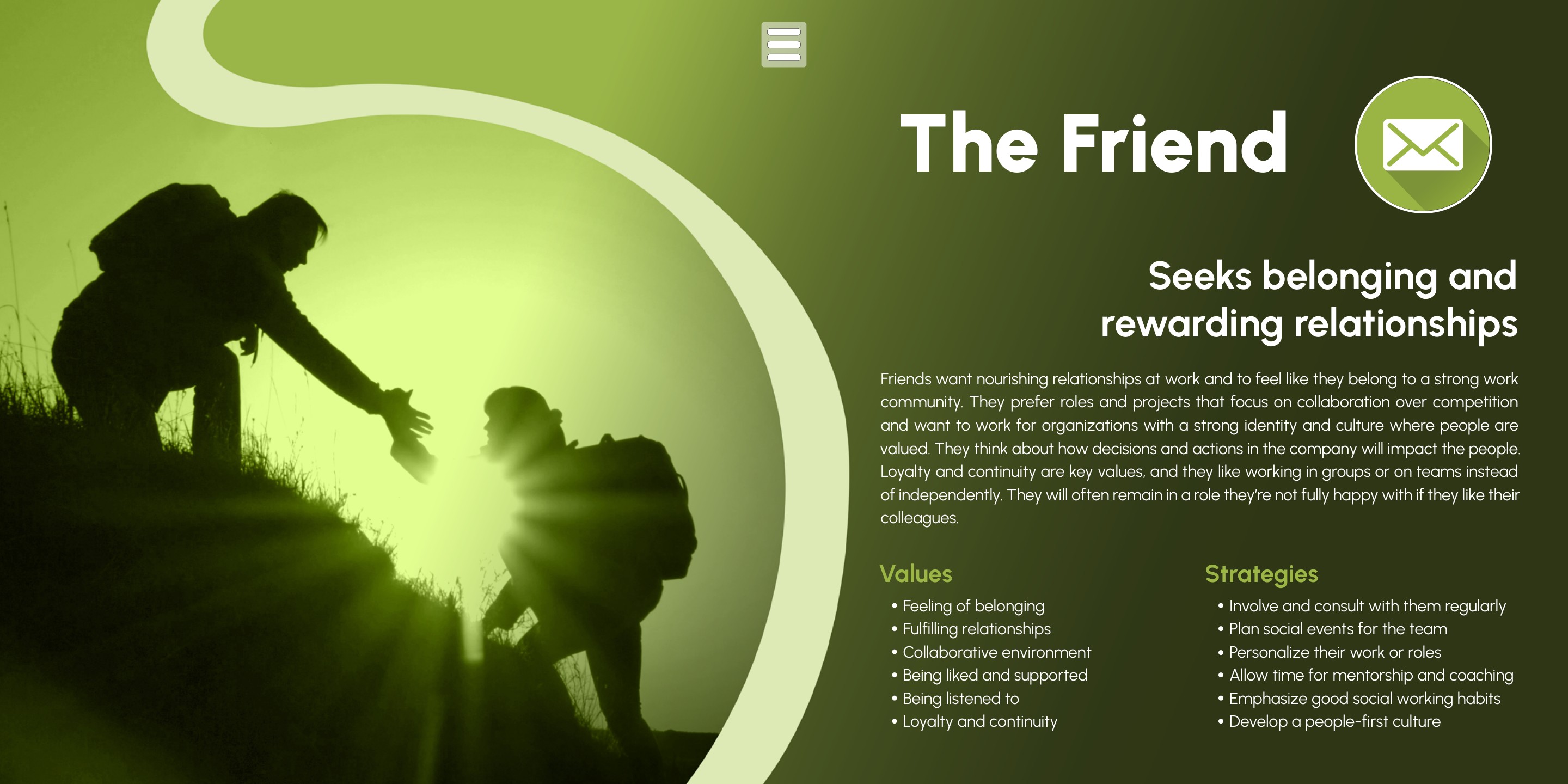
The "Friend card." Click image for a full view.
Shared time in the same place
When the right people are in the office all on the same day, someone with a high Friend motivator can still get the connection they need. But if they commute to find the rest of their team working from home, they can be actively demotivated or discouraged.
Even one absence can undercut a shared office day. Research on software engineers found that having just one teammate in a distant location reduced feedback among the teammates who sat together, suggesting that office days work best when the whole team is there, not just most of it.
Building relationships through work
Gallup reports that just 2 in 10 US employees have a best friend at work, yet those who do are significantly more likely to get more done in less time. A study of 121 hospitality employees over 10 workdays found that socializing with coworkers raised daily vitality, which strengthened attachment and helping.
Mentorship is one of the most reliable routes for building a relationship. In that same study on engineers, those who sat in the same building as all their teammates received 22% more feedback on their work than engineers with distant teammates, most of it flowing from experienced engineers to newer ones. When offices closed, that advantage largely disappeared.
A Harvard Business School field experiment with remote interns found something similar. Of four ways to connect them, only small video sessions with a senior manager improved outcomes, and only when the sessions met regularly or paired interns with a manager of a similar demographic background. Peer-only hangouts — focused socialization time — didn't help.
This is an important takeaway for managers. Socialization woven into the workplace has a different effect from scheduled social programming. People with a high Friend motivator are not looking to make work a place to socialize. Instead, they learn, work, and communicate better through more human connections and in an environment where the relationships between people are supported.
Protecting Friends from their own generosity
Employees who invest in relationships tend to take on more than their share of mentoring, welcoming new people, and smoothing over friction. None of that work is measured in a performance review or a KPI.
Team members with high Expert, Director, or Defender motivators can also be valuable sources of mentoring and orienting people, but managers may need to encourage it so that someone with a high Friend isn’t always the one volunteering or graciously accepting when the group volunteers them.
Curious which of your employees have a strong Friend motivator? Get in touch for a free map of your motivators.
At 1,000+ employees, connection needs a plan
At organizations with 1,000 or more employees, connections can break down across several points and across different teams, and most managers haven't been trained to spot that. Gallup found that only 21% of hybrid workers have received training on working effectively in a hybrid environment, and just 28% of hybrid managers are trained by their organization to lead a hybrid team.
Connection must be designed at the organization level. Set anchor-day and meeting norms across teams, build cross-team partnerships and mentoring into how teams operate, and train managers to ask for what Friends won't raise on their own and to notice who is carrying the relationship work.
Then use mojo to see where support is needed most. Its organizational view rolls up results across teams, and because employees retake their maps every quarter, managers can see whether Friend satisfaction moved after an action plan took effect.
Sources
Choudhury, Prithwiraj, et al. "Virtual Water Coolers: A Field Experiment on the Role of Virtual Interactions on Organizational Newcomer Performance." Harvard Business School Working Paper 21-125, 2021.
Emanuel, Natalia, et al. "The Power of Proximity: How Working beside Colleagues Affects Training and Productivity." Federal Reserve Bank of New York, Liberty Street Economics, January 18, 2024.
Gallup. "How to Boost Productivity in Hybrid Teams." 2024.
Gallup. "The Increasing Importance of a Best Friend at Work." 2022, updated 2024.
Google re:Work. "Understand Team Effectiveness."
Petriglieri, Gianpiero, et al. "Agony and Ecstasy in the Gig Economy: Cultivating Holding Environments for Precarious and Personalized Work Identities." Administrative Science Quarterly 64, no. 1 (2019).
Tews, Michael J., et al. "Strengthening Workplace Connections Through Coworker Socializing and Managerial Support for Fun." Journal of Business and Psychology, 2026.
Yang, Longqi, et al. "The Effects of Remote Work on Collaboration Among Information Workers." Nature Human Behaviour, 2021.